
New Jersey MVC Permit Practice Test 23
- Questions50
- Correct to pass40
- Passing score80%
- Minimum age16 years
-
1. A yellow pennant-shaped sign is posted on the left side of a two-lane road facing you. What is it telling you?
Show answer
Answer B: You are entering a no-passing zone and may not start a pass
The pennant is placed on the left so that it faces the driver who might pull out, and it marks the beginning of a no-passing zone.
-
2. Is dictating a message by voice a safe alternative to typing one?
Show answer
Answer C: No, it still takes attention from driving
Composing and checking a spoken message loads the mind and usually pulls the eyes to the screen anyway, so research finds it no safer than other phone use.
-
3. A traffic signal is displaying a flashing red light. How must you treat it?
Show answer
Answer D: Stop completely, then proceed when the way is clear
A flashing red carries the same meaning as a stop sign: come to a full stop, then go only when it is safe.
-
4. Where are signs of this kind placed at an intersection?
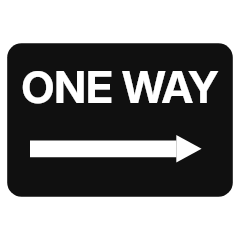
Show answer
Answer C: At the near right and far left corners, facing drivers on the intersecting street
They are installed at the corners of the intersecting street so that a driver about to turn in sees the restriction before committing to the turn.
-
5. May you exceed the posted speed limit in order to complete a pass?
Show answer
Answer C: No, the posted limit applies while you are passing too
The limit does not lift for passing; if you cannot complete the pass within it, there is not enough room and you should stay back.
-
6. You reach a T intersection where the cross street has a ONE WAY sign pointing to the right. What may you do?
Show answer
Answer B: Turn right only, because the street carries traffic in that direction
The arrow shows the only direction traffic may travel, so the only legal movement from the terminating road is a right turn.
-
7. A driver slows to walking pace at this sign, never stops rolling and eases into the intersection. How is that treated?

Show answer
Answer B: It is a violation, because the vehicle never came to a complete halt
What is required is a full halt with the wheels no longer turning, so slowing down, however carefully, does not satisfy it.
-
8. You are the second vehicle waiting to turn left on a green ball. Where should you wait?
Show answer
Answer A: Behind the stop line, until the first vehicle has actually turned
Only the lead vehicle should move into the intersection to wait; a second vehicle inside it is likely to be stranded there when the light changes.
-
9. How does New Jersey enforce the seat belt rule for unbelted rear seat passengers aged 18 or over?
Show answer
Answer D: As a secondary offense, ticketed only if the vehicle is stopped for another reason
Rear seat occupants 18 and over may be summonsed only when the vehicle has been stopped for some other reason; the front seat and under-18 rules are primary offenses.
-
10. Where is a U-turn most clearly unsafe and generally prohibited?
Show answer
Answer D: On a curve or near a hill crest, where other drivers cannot see you
U-turns are barred where approaching drivers cannot see you in time, such as on a curve or near the top of a hill.
-
11. You are in the right-hand lane of a multilane street and that lane becomes a right-turn-only lane ahead, but you want to go straight. What should you do?
Show answer
Answer B: Change into a through lane before you reach the markings for the turn lane
A lane-use arrow is a regulatory marking, so a driver who wants to continue straight has to leave that lane before it becomes a mandatory turn lane.
-
12. The street you are turning right onto has a bike lane along its right edge. Where should your vehicle end up?
Show answer
Answer B: In the first traffic lane to the left of the bike lane
A bike lane is not a travel lane for motor vehicles, so the nearest lane you may finish a right turn in is the first general traffic lane beside it.
-
13. You find that your shoulder belt has some slack in it. Why does that matter?
Show answer
Answer D: You travel further before the belt restrains you, so injuries are worse
Slack lets your body build up speed before the belt takes hold, which increases the forces on you and the risk of hitting the interior.
-
14. What must a New Jersey graduated driver license holder under 21 display on the vehicle being driven?
Show answer
Answer C: Two red reflective decals, one on the front plate and one on the rear plate
Red reflective decals go on the upper left corner of both license plates, and failing to display them carries a 100 dollar fine.
-
15. Smoke and flames appear from the engine compartment after you stop. What should you do?
Show answer
Answer A: Get everyone well away from the vehicle first, and then call the fire service
A vehicle fire can spread within seconds, so people come out first and firefighting is left to the fire service.
-
16. How should your following distance change in heavy rain?
Show answer
Answer D: It should be increased well beyond what you use on dry pavement
Wet pavement lengthens stopping distance and rain cuts visibility at the same time, so a larger gap gives you the extra seconds needed to see a problem and stop for it.
-
17. You have just passed a large truck on the freeway. Why is it dangerous to pull back in front of it and then brake for your exit?
Show answer
Answer B: A loaded truck needs much more distance to stop than a car
A fully loaded tractor-trailer can need the length of a football field or more to stop from highway speed. Cutting in and braking leaves the driver no room to avoid hitting you.
-
18. What counts as a complete stop at a stop sign?
Show answer
Answer C: The wheels stop turning before the stop line
A legal stop means the vehicle is no longer moving, made at the stop line or before entering the crosswalk or intersection.
-
19. Why should cruise control be switched off on wet, snowy or icy roads?
Show answer
Answer B: It may keep feeding power to a wheel that has started to slip, and cancelling it costs you time
Cruise control holds a set speed regardless of grip, so it can add power just as a tire loses traction, and the extra step of cancelling it delays your response.
-
20. On loose gravel or deep fresh snow, how does an antilock system affect the stopping distance?
Show answer
Answer D: It can lengthen it, although you keep the ability to steer
On loose surfaces a locked wheel piles up a wedge of gravel or snow that helps it stop, so the antilock stop can be longer even though steering still works.
-
21. Which combination best reduces the chance of hydroplaning?
Show answer
Answer D: Good tread depth, correct tire pressure and lower speed in the rain
Tread channels water away, correct pressure keeps the tire's shape, and lower speed gives the tire time to push water aside. Hydroplaning can begin at surprisingly modest speeds.
-
22. How long should a glance at a mirror or an instrument take?
Show answer
Answer A: A brief glance of about a second, returning your eyes to the road at once
Checks should be quick flicks of the eyes. At highway speed, a few seconds with your eyes off the road covers a distance long enough for a hazard to appear.
-
23. You are already inside a roundabout when an emergency vehicle approaches with lights and siren. What should you do?
Show answer
Answer B: Continue to your exit, leave the roundabout, then pull over and stop
Stopping inside a roundabout blocks the circulating roadway, so you should exit first and then pull over clear of the intersection.
-
24. A bicyclist ahead of you puts the left arm straight out to the side. What is being signaled?
Show answer
Answer B: A left turn or a move to the left
The left arm held straight out is the bicycle signal for a left turn, so hold back and give the rider room to cross toward the center.
-
25. In New Jersey, what blood alcohol concentration makes a driver 21 or older guilty of driving while intoxicated?
Show answer
Answer C: 0.08 percent or higher
New Jersey law makes it illegal to drive with a blood alcohol concentration of 0.08 percent or more, and higher readings bring longer forfeiture periods and interlock requirements.
-
26. A hands free phone conversation is which kind of distraction?
Show answer
Answer C: Cognitive, because your mind leaves the road
Hands free equipment removes the manual and visual parts of a call but not the mental load, and it is the mental load that makes a driver miss hazards.
-
27. Which of these is announced with the same family of signs as the facility shown here?
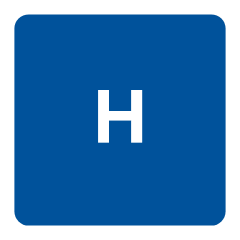
Show answer
Answer A: A rest area for travelers
A rest area belongs to the same motorist service series, which points travelers toward facilities such as fuel, food, lodging and medical care.
-
28. A sign reads END SCHOOL ZONE. What does it tell a driver?
Show answer
Answer A: The regular limit for that road applies again
An end of restriction sign marks the downstream limit of a special zone, after which the ordinary speed limit for that road governs again.
-
29. At an intersection where turning right on red is permitted and no sign prohibits it, what must you do before turning?
Show answer
Answer A: Come to a complete stop and yield to pedestrians and cross traffic
A right turn on red is allowed only after a full stop, and the turning driver must yield to pedestrians in the crosswalk and to traffic already using the intersection.
-
30. What is the fine for a first New Jersey offense of carrying an open alcoholic beverage container in a vehicle's passenger area?
Show answer
Answer D: $200
The first offense costs $200; later offenses cost $250 or ten days of community service, and the same rule covers unsealed cannabis items.
-
31. Why is a sign reading BRIDGE ICES BEFORE ROAD worth heeding even when the road itself is merely wet?
Show answer
Answer C: Cold air passes under a bridge as well as over it
A bridge deck loses heat from below as well as above, so it can be frozen while the road on either side of it is only wet.
-
32. You and an oncoming driver are both turning left at the same intersection. What is the usual rule?
Show answer
Answer D: Both turn in front of each other unless markings show otherwise
The normal practice is to pass driver side to driver side, turning in front of one another, unless pavement markings or signs direct a different path.
-
33. While you wait for the ambulance at a crash, what is the most useful help you can give?
Show answer
Answer C: Keep the person still and warm, and press down firmly on any heavy bleeding
Keeping an injured person still and warm and controlling bleeding are among the few things a bystander can safely do.
-
34. A raised area crosses the roadway and carries a series of white markings on its face. What are those markings for?
Show answer
Answer A: To make the hump visible so drivers slow for it
Speed hump markings warn drivers that the pavement rises, which matters most at night or when the hump is in shadow.
-
35. What should you expect while driving through a parking lot?
Show answer
Answer D: Pedestrians and vehicles moving from any direction, so drive slowly
Parking lots mix walking people, reversing vehicles and poor sight lines, so low speed and constant scanning are the only reliable protection.
-
36. Beyond the point this sign refers to, which movement becomes unlawful?
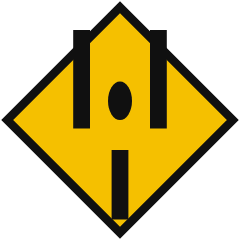
Show answer
Answer D: Driving on the far side of the separation, against the flow
Once the two directions are separated, each roadway carries one-way traffic, so crossing to the other side means driving into oncoming vehicles.
-
37. A vehicle is sitting in your blind spot and you need to change into that lane. What should you do?
Show answer
Answer B: Adjust your speed to open a clear gap, then check again and move over
Changing your speed either drops the other vehicle behind you or lets it move ahead, which turns the blind spot back into open space.
-
38. A sign reads REDUCED SPEED LIMIT AHEAD. What does it tell you?
Show answer
Answer D: A lower limit begins further along the road
The sign gives advance notice so a driver can slow gradually, and the new figure takes effect at the speed limit sign that follows.
-
39. What is the status of hands-free phone use for a fully licensed New Jersey driver?
Show answer
Answer C: It is legal, if it does not interfere with safety equipment or safe operation
New Jersey permits hands-free use by fully licensed drivers so long as it does not interfere with federally required safety equipment or the safe operation of the vehicle.
-
40. A driver on a hands free call looks straight at a red light and drives through it. What best explains this?
Show answer
Answer B: The eyes saw it but the brain did not process it
Attention, not eyesight, decides what a driver actually sees, and a loaded mind can leave a driver looking straight at a hazard without registering it.
-
41. What is the correct order of steps as you finish parking an automatic on a grade?
Show answer
Answer C: Turn the wheels, set the parking brake, then select park
Setting the parking brake before shifting into park lets the brake take the load, instead of leaving the whole weight of the car on the parking pawl.
-
42. What happens when alcohol is combined with another drug that also affects the nervous system?
Show answer
Answer B: Impairment is often far greater than either one alone would produce
Combined substances can multiply each other's effects, producing impairment well beyond what a driver would expect from either one taken separately.
-
43. You are starting from a stop on a snowy, icy street and the drive wheels begin to spin. What should you do?
Show answer
Answer C: Ease off the accelerator and start again more gently
Spinning tires polish the surface and dig in. Very gentle pressure on the accelerator, and a higher gear if you have one, gives the tires the best chance to grip.
-
44. When should you enter a destination into a navigation device?
Show answer
Answer B: Before you start driving, or after parking in a safe place
Programming a route is a visual, manual and mental task at the same time, so it belongs to the moments before the vehicle moves rather than to any point in traffic.
-
45. On the Interstate system, what do the odd-numbered one and two digit routes have in common?
Show answer
Answer D: They run mainly north and south
Odd numbers are given to north and south Interstates and even numbers to east and west ones, with the numbers rising toward the north and the east.
-
46. You have stopped at a stop line but parked cars hide the cross street. What comes next?
Show answer
Answer C: Edge forward to where you can see, stopping again if needed
The legal stop at the line is only the first stop; you then move up slowly to a point where you can see, and stop again if traffic requires it.
-
47. A child seat was in the car during a moderate crash. What should be done with it?
Show answer
Answer A: Replace it, because a seat that has been through a crash may be weakened
Crash forces can damage a seat in ways you cannot see, so a seat involved in anything but the mildest crash is replaced.
-
48. The vehicle ahead of you has pulled out to pass a truck. May you follow it out and pass as well?
Show answer
Answer B: No, wait until it is done and judge the road for yourself
You cannot see past the vehicle ahead of you, and if it has to abort the pass there is nowhere for either of you to go.
-
49. Where exactly must the red GDL decals be placed on a New Jersey vehicle's license plates?
Show answer
Answer A: On the top left corner of both the front and the rear plate
One decal goes on the top left corner of the rear plate and the other on the top left corner of the front plate.
-
50. What is the minimum age for a New Jersey driver examination permit?
Show answer
Answer A: 17 years old
Any New Jersey resident who is at least 17 and not under suspension may buy an examination permit; a 16 year old can only get a special learner permit through an approved driver training course.