
New Jersey MVC Motorcycle Practice Test 12
- Questions50
- Correct to pass40
- Passing score80%
- Minimum age17 years
-
1. How should space management change with a passenger aboard?
Show answer
Answer B: Allow a greater following distance and wait for larger gaps in traffic
A loaded motorcycle accelerates and stops more slowly, so it needs more room ahead and bigger gaps to merge, to pass or to cross traffic.
-
2. You are waiting to turn left and an oncoming vehicle stopped in the near lane to turn left blocks your view of the far lane. What should you do?
Show answer
Answer A: Wait where you are until you can see that the far lane is completely clear
The lane you cannot see is where the crash comes from, so you hold your position until the view opens up.
-
3. While you swerve around an obstacle, what should the rest of your body be doing?
Show answer
Answer C: Staying upright with the knees against the tank while the motorcycle leans
A swerve happens through the handlebars, and a body that stays still and anchored to the tank lets the motorcycle move quickly beneath the rider.
-
4. You are turning right where a paved trail crosses the road just past the corner. What should you look for?
Show answer
Answer B: Cyclists and walkers arriving from either direction on the trail
A shared use path carries two-way traffic on foot and on bicycles, so scan both directions along the trail before crossing it.
-
5. A group has just stopped at a stop sign. How should the formation be restored?
Show answer
Answer B: Riders should pull away one at a time and take up the stagger once moving
Motorcycles need room to pull away and get up to speed, so the staggered formation is taken up again only after the riders are rolling.
-
6. A large truck passes and hits you with a blast of wind. Which lane position leaves you the most room for error?
Show answer
Answer A: The center portion of the lane
A rider in the center portion of the lane has space on both sides to absorb the push of a wind blast without being shoved out of the lane.
-
7. Besides a chemical test, what else supports an impaired driving charge?
Show answer
Answer B: The officer's observations of the driving and the driver
Weaving, slow responses, speech and balance observed by the officer are evidence in their own right, which is why a driver can be charged on behavior alone.
-
8. Why should reflective material be placed on the front, back and sides of a rider's gear?
Show answer
Answer D: A driver may approach the rider from any of those directions
Threats come from ahead, behind and from the sides at intersections, so reflective material should be visible from every direction a vehicle can approach.
-
9. You find that the road surface has turned to sheet ice. What speed is appropriate?
Show answer
Answer A: A crawl, slow enough that you could stop without braking hard
Ice can cut grip to a fraction of normal, so stopping takes many times the usual distance and only a crawl leaves any margin.
-
10. What does a sign reading Slower Traffic Keep Right require?
Show answer
Answer C: Traffic moving slower than the general flow must use the right-hand lane
The sign applies to any vehicle traveling below the speed of the traffic around it, which must keep right so faster vehicles can use the lanes to the left.
-
11. You notice at night that one of your headlights has burned out. What should you do?
Show answer
Answer B: Get it replaced promptly, because other drivers may take you for a motorcycle
A single light makes your vehicle look narrower and further away, so other drivers misjudge you, and one light is also illegal.
-
12. Which action makes a wobble worse instead of better?
Show answer
Answer A: Braking or accelerating to try to ride out of it
Braking or adding power during a wobble can amplify it. Close the throttle gradually, hold the bars firmly and let the speed fall until the machine settles.
-
13. Why is a motorcycle particularly hard for other drivers to judge at night?
Show answer
Answer A: Its single headlight gives no width cues for distance and speed
Drivers judge distance from the spacing between a pair of headlights, and a single lamp gives them nothing to measure, so they routinely misjudge how close and how fast a motorcycle is.
-
14. Why is a wet road at night harder to read than the same road in daylight?
Show answer
Answer A: The wet surface reflects light away and swallows the lane markings
A film of water sends your headlight beam onward instead of back to you, so lines, edges and people in dark clothing almost disappear.
-
15. What does a tire with worn tread do on a wet road?
Show answer
Answer B: It loses grip and it hydroplanes at a lower speed than a good tire
Tread grooves carry water away from the contact patch, and a worn tire cannot do that, so it floats on the water sooner.
-
16. An orange sign showing the symbol of a person holding a flag or a sign paddle means that
Show answer
Answer D: a person is controlling traffic ahead and the driver must obey that person
The flagger sign warns that a trained flagger is directing traffic further on, and the flagger's instructions govern movement through the work zone.
-
17. A bee gets inside your jacket while you are riding. What is the recommended action?
Show answer
Answer B: Pull off the road and stop before you try to deal with the insect
Being stung hurts, but losing control while swatting hurts much more, so ride to a safe place, stop and then deal with the insect.
-
18. Another driver is behaving aggressively toward you. What should you do?
Show answer
Answer D: Avoid eye contact, give them room to go on their way and do not respond to provocation
Responding to an aggressive driver escalates the conflict, while creating distance and refusing to engage takes you out of the situation. Report serious threats once you can do so safely.
-
19. On dry pavement in good weather, what is the smallest following gap you should keep?
Show answer
Answer A: About three seconds behind the vehicle ahead
Three seconds is the accepted minimum on dry roads in good visibility, and the gap should be longer in poor conditions.
-
20. Which of these makes you unpredictable to other drivers?
Show answer
Answer B: Changing lanes suddenly without signaling, to save a moment
An unsignalled, sudden lane change gives nobody time to react and is a common cause of sideswipe collisions.
-
21. Your vehicle has antilock brakes. What should you never do in an emergency stop?
Show answer
Answer A: Pump the pedal up and down
The system already releases and reapplies the brakes many times a second. Pumping the pedal interrupts it and makes the stop longer.
-
22. What happens when a New Jersey driver accumulates six or more points within three years?
Show answer
Answer A: A surcharge of $150 plus $25 for each additional point
Six points within three years brings a 150 dollar surcharge, with 25 dollars added for every point above six, charged in addition to court fines.
-
23. A bicyclist in the bike lane ahead of you signals and starts to move left toward the turn lane. What should you do?
Show answer
Answer A: Slow down and let the rider move across
A bicyclist who needs to leave the bike lane to turn left is changing lanes like any driver, and following traffic should make room.
-
24. You are joining a highway from a short ramp that has no acceleration lane. What should you do?
Show answer
Answer A: Stop or slow at the end of the ramp and wait for a safe gap
Without an acceleration lane there is no room to match speed, so you must yield at the end of the ramp and enter only when a gap allows it.
-
25. Why are sign shapes and colors standardized across the whole country?
Show answer
Answer D: So a driver knows the kind of message before reading it
Uniform shapes and colors let a driver classify a sign as regulatory, warning or guide from a distance, before the legend can be read.
-
26. Which family of signs normally uses a rectangle that is wider than it is tall?
Show answer
Answer B: Guide signs, which name routes and destinations
Guide signs are laid out as horizontal rectangles because they have to carry route numbers, place names and distances side by side.
-
27. You have driven at 70 mph for an hour and then exit onto a town street. What is the common risk?
Show answer
Answer B: Your sense of speed adapts, so 35 mph feels slow and you drive too fast
After a long stretch at high speed the brain adapts, so town speeds feel unnaturally slow; check the speedometer instead of trusting the feeling.
-
28. The lane you are in has a right-turn-only arrow painted on the pavement. What must you do?
Show answer
Answer C: Turn right, because a lane-use arrow is a legal requirement
Lane-use arrows painted on the pavement are regulatory markings, so a driver in that lane must travel in the direction shown.
-
29. What fine range applies to a first New Jersey conviction for using a handheld phone while driving?
Show answer
Answer D: $200 to $400
A first handheld phone offense costs 200 to 400 dollars, and because it is a primary offense an officer may stop a driver for it alone.
-
30. A downpour has just started on a street with a visible dark strip down the middle of the lane. Where should you ride?
Show answer
Answer A: In the left or right portion of the lane, away from the greasy center strip
Dripped oil and grease build up in the center of the lane, and water floats that film to the top, so the tire tracks on either side offer better grip.
-
31. On a rural road, the driver of a slow farm tractor ahead of you signals a left turn even though there is no road or driveway in sight. What should you do?
Show answer
Answer B: Stay behind the tractor, because it may be turning into a field entrance
Farm equipment often turns into fields through gaps you cannot see, and it may swing wide to do so. Passing a vehicle that is signaling a left turn is a common cause of crashes.
-
32. What must a driver be prepared to do at the point this sign refers to?
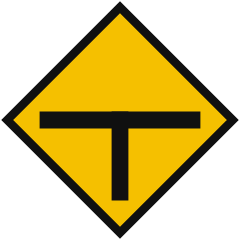
Show answer
Answer D: Turn left or right, because the road being traveled ends there
The road ends at another roadway, so the driver must slow, give way to traffic on the through road and turn in one direction or the other.
-
33. You are turning right from a one-way street onto a two-way street. Where should the turn end?
Show answer
Answer A: In the lane nearest the right curb of the street you are entering
A right turn starts and finishes as close to the right as practical, so you leave the one-way street from the right lane and arrive in the lane nearest the right curb.
-
34. How far ahead should you normally be looking as you drive?
Show answer
Answer C: About 12 to 15 seconds ahead, well beyond the vehicle in front
Looking that far down the road lets you see a problem developing and slow smoothly, instead of discovering it in time only for hard braking.
-
35. A yellow diamond showing the silhouette of a deer warns that
Show answer
Answer D: large animals may cross the road in that area
The sign marks a stretch where animals are known to cross, so drivers should reduce speed and scan both roadsides, especially around dawn and dusk.
-
36. Your face shield develops a crack across the middle. What should you do?
Show answer
Answer D: Replace the shield, because a crack scatters light and can fail
A cracked shield distorts your view, scatters light badly at night and can break apart in an impact, so it should be replaced rather than repaired.
-
37. You are approaching a highway-rail grade crossing marked only with a crossbuck sign. What does that sign require?
Show answer
Answer A: Yield to any approaching train and cross only when the tracks are clear
The crossbuck is a regulatory yield sign, and a train can never stop or steer around a vehicle, so the driver must always give way.
-
38. Why should a rider downshift one gear at a time instead of skipping several at once?
Show answer
Answer D: Skipping gears can lock the rear wheel through sudden engine braking
Dropping several gears at once forces engine speed far above what road speed supports, and the rear tire can be dragged into a skid when the clutch comes out.
-
39. Lights set into the pavement along both edges of a crosswalk start to flash yellow as you approach. What do they tell you?
Show answer
Answer D: Someone is crossing and has to be given way
In-roadway warning lights flash only when a pedestrian activates the crossing, so a flashing pattern means somebody is in or entering the crosswalk.
-
40. Why is a U-turn on a one-way street a problem?
Show answer
Answer A: You would end up facing the wrong way against all the traffic
Every lane of a one-way street runs the same way, so turning around leaves you driving head-on against all of the traffic.
-
41. What does research say about the effect of a full coverage helmet on a rider's ability to see and hear traffic?
Show answer
Answer B: It leaves the view and the useful hearing a rider needs largely intact
Certified helmets leave far more peripheral vision than a rider needs to check traffic, and riders wearing them still hear the sounds that matter.
-
42. What should a rider confirm about the transmission before starting the engine?
Show answer
Answer B: That it is in neutral, or that the clutch lever is squeezed all the way in
Starting in gear with the clutch engaged can make the motorcycle lurch forward, so the machine must be in neutral or the clutch held in.
-
43. What should the clutch be doing during a quick stop?
Show answer
Answer C: Pulled in as the motorcycle slows, so the engine does not stall
Disengaging the clutch as the machine slows keeps the engine running, so the rider can pull away again immediately if that becomes necessary.
-
44. An overhead lane-use control signal shows a steady red X above the lane you are traveling in. What does it require?
Show answer
Answer D: Leave that lane, because it is closed to you
A steady red X means road users are not permitted to use the lane beneath it, so you must move into a lane that is open.
-
45. You are driving in the left lane at the posted speed limit and a line of vehicles has built up behind you. What should you do?
Show answer
Answer D: Move into a lane on your right when it is safe and let the traffic behind go by
Most states require traffic moving slower than the flow to keep right and reserve the left lane for passing, so a driver holding up a line of vehicles should move right when it is safe rather than block the lane.
-
46. You are stopped facing uphill on a steep grade and need to pull away. What is the recommended technique?
Show answer
Answer D: Hold with the rear brake, ease the clutch into the friction zone, then release
The rear brake keeps the motorcycle from rolling backward while the clutch takes up the drive, and it is released as the throttle is opened.
-
47. Once the motorcycle is leaned over and settled in a curve, what should the throttle be doing?
Show answer
Answer C: Held steady or rolled on gently through the curve
A steady or slightly increasing throttle keeps the suspension settled and the weight balanced, while closing it mid-curve unloads the rear tire.
-
48. May you exceed the posted speed limit in order to complete a pass?
Show answer
Answer C: No, the posted limit applies while you are passing too
The limit does not lift for passing; if you cannot complete the pass within it, there is not enough room and you should stay back.
-
49. Why is passing another vehicle a bad idea in dense fog?
Show answer
Answer C: You cannot see far enough ahead to know the passing lane is clear
A pass needs a clear view of the road well beyond the vehicle you are overtaking, and fog takes exactly that away.
-
50. A driver is following you far too closely. What is the best response?
Show answer
Answer D: Increase your own following distance and let the driver pass when it is safe
More room ahead of you means you can slow gradually instead of braking hard, which reduces the chance of being struck from behind, and letting the driver by removes the problem entirely.