
New Jersey MVC Motorcycle Practice Test 15
- Questions50
- Correct to pass40
- Passing score80%
- Minimum age17 years
-
1. You come around a bend and find loose sand spread across your lane. What should you do?
Show answer
Answer D: Ease off the gas, avoid sudden braking or steering, and keep straight
Loose material acts like ball bearings under the tires; smooth inputs preserve what little grip remains, while sudden braking or steering breaks it.
-
2. Which rough check suggests that a helmet is a novelty shell rather than a certified helmet?
Show answer
Answer C: It weighs about a pound, far less than a certified helmet
A certified helmet weighs roughly three pounds because of its shell and thick liner, while a novelty shell is very light. Weight is only a clue, and the certification label is the real check.
-
3. A large electronic advertising sign beside the road catches your eye. What should you do?
Show answer
Answer A: Glance briefly and return your eyes to the road
Bright changing displays are designed to hold attention, so treat them like any roadside object and give them no more than a brief glance.
-
4. From which lane should a permitted U-turn be started?
Show answer
Answer A: The lane nearest the center line, the same one used for a left turn
A U-turn is begun from the far left lane for your direction, the same position used for a left turn, so you do not cut across traffic beside you.
-
5. What does a swerve actually consist of?
Show answer
Answer B: Two quick presses on the grips, one to go around and one to come back
A swerve is two separate countersteering inputs made back to back, so the machine leaves the original path and then returns to it.
-
6. What is the correct way to ride across a stretch of slippery pavement?
Show answer
Answer C: Reduce speed before you reach it, avoid sudden moves, and use both brakes gently if you must brake
The speed must come off before the slippery area, and once the tires are on it every input, braking included, has to be smooth and gentle.
-
7. There is a driveway and a side street between you and the corner where you will turn right. When should you signal?
Show answer
Answer C: After passing the openings, so nobody pulls out in front of you
A signal switched on before an opening tells drivers waiting there that you are turning in, and they may pull out into your path.
-
8. A regulatory sign posted at the start of a road reads LENGTH LIMIT 30 FEET. What does it control?
Show answer
Answer B: The overall length of vehicle allowed on that road
Some states post a length limit where tight curves or narrow structures lie ahead; it bars vehicles or combinations longer than the figure shown from using that road.
-
9. In normal operation, which indication always comes between a green and a red on the same signal face?
Show answer
Answer C: A steady yellow
The yellow change interval must follow every green or green arrow, so a signal can never jump straight from green to red.
-
10. What happens when alcohol is combined with another drug that also affects the nervous system?
Show answer
Answer B: Impairment is often far greater than either one alone would produce
Combined substances can multiply each other's effects, producing impairment well beyond what a driver would expect from either one taken separately.
-
11. Which part of the space around your vehicle can you control best?
Show answer
Answer A: The space ahead of you
You choose your own following distance, so the gap in front is the space you truly control and the one that gives you time to react.
-
12. Why should a rider pull in the clutch at the first sign that the engine is seizing?
Show answer
Answer B: So a locking engine cannot lock the rear wheel through the drive train
A seizing engine can lock up, and with the clutch engaged that would lock the rear wheel, so disconnecting the drive keeps the wheel rolling while you coast off the road.
-
13. What is the purpose of a wide solid white line painted straight across your lane on the approach to an intersection?
Show answer
Answer C: It shows the point where a required stop must be made
A stop line indicates the point at which the stop required by a signal or a stop sign is to be made, ahead of the crosswalk and the intersection.
-
14. A driver disregards this sign and turns so as to travel against the direction it establishes. What is the immediate danger?
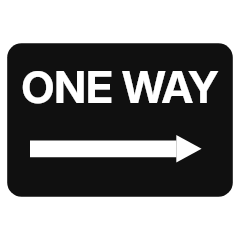
Show answer
Answer D: The driver will face traffic head on, because every lane comes the other way
Turning against the established direction puts the vehicle nose to nose with all the traffic on that street, which is why the mistake has to be corrected at once.
-
15. Two left-turn lanes are available and you must turn right again a short distance after the turn. Which of the two should you use?
Show answer
Answer D: The right one, so you finish nearer the right side of the new street
Each turn lane feeds the matching lane of the new street, so choosing the right-hand of the two left-turn lanes leaves you closer to the side you will need.
-
16. Where should a rider with a disabled motorcycle try to stop?
Show answer
Answer D: Well clear of the traffic lanes, off the shoulder where there is room
Getting completely away from moving traffic protects the stopped rider and anyone helping, and a shoulder alone is not a safe place to work on a machine.
-
17. You are riding up an entrance ramp to merge onto a freeway. What should you do?
Show answer
Answer D: Build up to traffic speed on the ramp, then signal and check the blind spot
Matching the speed of freeway traffic before merging avoids forcing others to brake, and a head check covers the area the mirrors do not show.
-
18. You are on a city street with two lanes in your direction, cars parked along the curb and driveways every few yards. Which lane is usually safer?
Show answer
Answer B: The lane farther from the curb, away from opening doors and vehicles pulling out
Most of the hazards on such a street come from the curb side, so the inside lane gives you more space and more time to react.
-
19. In New Jersey, what blood alcohol concentration makes a driver 21 or older guilty of driving while intoxicated?
Show answer
Answer C: 0.08 percent or higher
New Jersey law makes it illegal to drive with a blood alcohol concentration of 0.08 percent or more, and higher readings bring longer forfeiture periods and interlock requirements.
-
20. How should a rider use a motorcycle fitted with antilock brakes in an emergency stop?
Show answer
Answer D: Apply firm, steady pressure to both brakes and keep it there
An antilock system releases and reapplies pressure far faster than a rider can, but only while the rider keeps holding the brakes on.
-
21. Where should a rider in the middle of a group direct their attention?
Show answer
Answer A: Well ahead through the group and around it, not just at the rider in front
Watching only the machine ahead hides the traffic and hazards further up the road, and it leaves the rider reacting late to everything the group meets.
-
22. Why can a mild afternoon still chill a rider dangerously on the highway?
Show answer
Answer B: Riding speed creates a wind chill well below the air temperature
Air moving over the body at highway speed strips heat far faster than still air, so a comfortable temperature at a standstill can cause serious chilling in an hour of riding.
-
23. You are waiting to turn and the traffic ahead has stopped. Where must you not come to rest?
Show answer
Answer D: On the crosswalk, which people need in order to cross the street
Stopping on a crosswalk forces pedestrians out into the traffic lanes to get around you, so you hold back before it instead.
-
24. You are riding on a multi-lane road with a car traveling beside you in the lane on your right. Which lane position is usually best?
Show answer
Answer D: The left portion, so you keep a cushion of space from the car alongside
Lane position is chosen to hold space between the motorcycle and the nearest hazard, and here that hazard is the vehicle on the right.
-
25. The vehicle you have borrowed is larger and heavier than your own. How should you drive it?
Show answer
Answer B: Allow more room for stopping and for turns until you are used to it
Extra weight and length mean longer stopping distances and wider turns, so give yourself more room until you are used to it.
-
26. A signal stands part way up a freeway entrance ramp and turns green briefly again and again. How many vehicles does such a signal normally release on each green?
Show answer
Answer A: One for each lane of the ramp
A ramp control signal releases a single vehicle per lane on each green so that vehicles reach the merge one at a time instead of in a bunch.
-
27. You are waiting to turn left at a solid green light with no green arrow. Oncoming traffic is approaching. What should you do?
Show answer
Answer A: Yield to the oncoming traffic and turn only when there is a safe gap
A solid green light permits the left turn but does not protect it, so you must yield to oncoming vehicles and to pedestrians before turning.
-
28. A United States numbered route is normally marked with
Show answer
Answer C: black numerals on a white shield
The U.S. route marker is a white shield carrying black numerals, which sets it apart at a glance from the red, white and blue Interstate shield.
-
29. How does alcohol typically affect a driver's vision?
Show answer
Answer D: It blurs vision, weakens night vision and narrows attention to the sides
Alcohol slows the eye muscles and the brain's processing of what is seen, degrading focus, night vision, depth perception and awareness of movement at the edges of the field of view.
-
30. The signal turns green as you approach an intersection. What is the safest practice?
Show answer
Answer B: Look left, then right, then left again, and make sure the intersection is clear before entering
A green light gives permission but does not guarantee the intersection is empty, and a quick scan catches a vehicle running the red or a pedestrian still crossing.
-
31. When is it safe to return to your own lane after passing a vehicle?
Show answer
Answer C: Once you can see the whole front of that vehicle in your mirror
Seeing the entire front of the vehicle in the mirror proves there is a full vehicle length of clear road, which the rider cannot judge by feel alone.
-
32. Snow has covered the pavement markings on a two-lane road. How should a driver judge lane position?
Show answer
Answer B: By the tracks of other traffic and the roadside features
With the markings hidden, ruts left by earlier traffic, signs, poles and the line of the shoulder are the best clues to where the lane runs.
-
33. You are on a one-way street with two marked lanes. May you pass a slower vehicle on the right?
Show answer
Answer A: Yes, using the right lane, provided that the move is safe and signaled
On a roadway with two or more marked lanes in your direction, moving into the free lane and going by is a normal lane change rather than an unlawful pass.
-
34. Who should set the pace of a group ride?
Show answer
Answer A: The last rider in the group, so that nobody is forced to hurry to keep up
The tail ender sets the pace: every rider watches the mirrors for the rider behind, and if someone falls back the whole group slows a little to stay together.
-
35. Traffic is entering the freeway from a ramp ahead of you and you are in the right lane. What should you do?
Show answer
Answer C: Move to another lane if it is safe, or adjust your speed to make room
Merging drivers may have little room to adjust. Helping them in by changing lanes or easing your speed prevents conflicts even though they must legally yield to you.
-
36. How does braking distance change if you double your speed?
Show answer
Answer D: It grows much more than twice as long
Braking distance increases with the square of speed, so doubling speed roughly quadruples the distance needed to stop.
-
37. A broken white line separates your lane from the lane beside it. What does it indicate?
Show answer
Answer C: Both lanes carry traffic in the same direction and lane changes are permitted
White lines separate lanes of traffic moving in the same direction, and a broken white line means changing lanes across it is permitted when it is safe.
-
38. On loose gravel or deep fresh snow, how does an antilock system affect the stopping distance?
Show answer
Answer D: It can lengthen it, although you keep the ability to steer
On loose surfaces a locked wheel piles up a wedge of gravel or snow that helps it stop, so the antilock stop can be longer even though steering still works.
-
39. A law enforcement officer is directing traffic and waves you forward while the signal facing you shows red. What should you do?
Show answer
Answer A: Follow the officer's direction and proceed
Directions given by an officer controlling traffic take priority over signals, signs and pavement markings.
-
40. What does a broken line indicate, whatever color it is painted?
Show answer
Answer C: That crossing it is permitted
A broken line always describes a permissive condition, and the color then tells the driver whether the traffic beyond it runs the same way or the opposite way.
-
41. A disabled vehicle is blocking your lane on a two-lane road with a single solid yellow line on your side. What should you do?
Show answer
Answer C: Wait until the oncoming lane is clear, then go around carefully
The solid line prohibits overtaking a moving vehicle, but in most states a driver may go around an obstruction such as a disabled vehicle once the oncoming lane is clear and the move can be made safely.
-
42. You are approaching a sharp curve. When should you reduce your speed?
Show answer
Answer D: Before you enter the curve, so you can accelerate gently through it
Braking hard inside a curve uses up the traction that is already being demanded for cornering, so the slowing must be finished before you enter.
-
43. You are in the middle lane of a one-way street with three lanes when a police car approaches from behind with lights and siren. What should you do?
Show answer
Answer C: Pull to the nearest curb and stop clear of the lanes
On a one-way street you clear to whichever curb is closest, so the emergency vehicle gets a clear path down the open lanes.
-
44. You are riding in the middle of a tight cluster of cars on a multilane road. What is the best way to improve your safety?
Show answer
Answer C: Ride slightly faster or slower to open space and get clear of the cluster
A rider hemmed in on all sides has nowhere to go, so change your speed a little to open an escape path and leave the crowd.
-
45. Where should the least experienced riders be placed in a group?
Show answer
Answer C: Just behind the leader
Placing newer riders just behind the leader keeps the pace manageable for them and lets the more experienced riders behind keep an eye on them.
-
46. Your phone is in a mount on the dashboard rather than in your hand. What is true?
Show answer
Answer B: It still takes your eyes and mind off the road
A mount solves the hand problem but not the eye or the mind problem, and reading or tapping a mounted screen costs the same seconds of attention.
-
47. You are traveling a long distance on a highway with three lanes in your direction, at about the speed of the surrounding traffic. Which lane is generally the best choice?
Show answer
Answer C: The center lane, which keeps you clear of merging traffic and of overtaking traffic
On a three-lane roadway the center lane avoids both the ramp traffic on the right and the overtaking traffic on the left, so it usually has the steadiest flow.
-
48. Which surfaces usually offer less grip than the pavement around them when wet?
Show answer
Answer B: Painted markings, metal plates and bridge decks
Paint, steel and bridge decks all shed grip when wet or cold, so brake before you reach them rather than on top of them.
-
49. What is a manageable size for a single group of motorcycles?
Show answer
Answer A: No more than four or five riders
Four or five machines can hold a formation, stay in sight of one another and clear an intersection together, while larger groups quickly become unmanageable.
-
50. When is a wet road usually most slippery?
Show answer
Answer C: Just after the rain starts, before the surface oil is washed away
Oil and dirt lying on the pavement mix with the first water and cut traction badly until continued rain washes the residue to the side of the road.