
New Jersey MVC Motorcycle Practice Test 20
- Questions50
- Correct to pass40
- Passing score80%
- Minimum age17 years
-
1. A sign with a yellow background and a black legend generally conveys
Show answer
Answer B: a general warning
Yellow is the background color used for general warning signs, so a yellow sign tells the driver to expect something ahead rather than to obey a rule.
-
2. How far ahead should you normally be looking while driving?
Show answer
Answer D: About 12 to 15 seconds of travel ahead
Looking that far ahead, roughly a block in town and much farther on a highway, gives you time to see a problem developing and adjust before it becomes an emergency.
-
3. A driver is tailgating you. Why is it a bad idea to tap or stab the brakes to warn them?
Show answer
Answer C: Because it cuts the little space they have and can cause a crash
Brake checking removes the small margin the tailgater has left and can provoke a collision; add space in front of you instead and let them pass.
-
4. Why should riding gloves fit snugly?
Show answer
Answer C: So loose material does not dull your feel for the controls
Bunched or baggy material gets between your hand and the grip, so a close fitting glove keeps the feel for the throttle, clutch and brake lever.
-
5. On a regulatory sign, what does a red circle with a diagonal slash drawn over a symbol mean?
Show answer
Answer D: The movement or action shown by the symbol is prohibited
A red circle with a diagonal slash is the standard way of showing that the movement pictured inside it, such as a U-turn or a right turn, is not allowed.
-
6. How does riding in a formation change your responsibility for your own space cushion?
Show answer
Answer C: It does not change it, because each rider still manages their own space and decisions
A formation organizes the group, but every rider remains responsible for their own following distance, escape paths and riding decisions.
-
7. When should you turn on your signal before a turn or a lane change?
Show answer
Answer C: Well before the maneuver, so other drivers have time to react
A signal is a warning to others, so it has to be given far enough ahead of the maneuver that drivers and pedestrians can adjust.
-
8. A ball rolls into the street from between parked cars ahead of you. What should you expect and do?
Show answer
Answer A: Expect a child to follow it and be ready to stop
A ball is usually followed by a child who is watching the ball and not the traffic. Slow down and be prepared to stop immediately.
-
9. Why is parking against the flow of traffic dangerous even when nobody complains?
Show answer
Answer D: Because you had to cross traffic to get there and must cross again to leave
Parking on the wrong side means driving against traffic at both ends of the stop, and your reflectors and lights face the wrong way while you are there.
-
10. You are crossing a divided highway with a wide median. How should you treat the two roadways?
Show answer
Answer D: As two intersections, waiting in the median only when your vehicle fits
Each roadway of a divided highway is a separate intersection, and you should wait in the median only if it is long enough to hold your vehicle clear of both roadways.
-
11. How tight should the chin strap of a helmet be?
Show answer
Answer D: Snug under the jaw, tight enough that the helmet cannot be pulled off
A helmet only works if it stays on, so the strap must be fastened snugly under the jaw on every ride, including short ones.
-
12. A rider notices scalloped, uneven wear across the front tire. What does that suggest?
Show answer
Answer C: A suspension or wheel bearing fault that should be inspected
Cupped or scalloped wear normally points to worn fork components or loose wheel bearings letting the tire bounce as it rolls.
-
13. You realize at the last moment that you have passed the street where you meant to turn. What should you do?
Show answer
Answer D: Keep going and turn around where it is safe and legal
A missed turn is a minor inconvenience; braking suddenly, backing up or turning across traffic to recover it causes crashes.
-
14. Why is the front brake avoided during a very slow, tightly leaned turn?
Show answer
Answer D: It can upset the balance of a leaned machine and drop it at low speed
At low speed and full lock there is little momentum holding the motorcycle up, and the sudden weight shift from the front brake easily topples it.
-
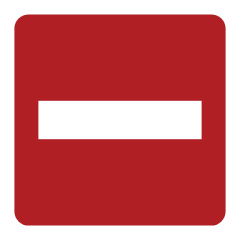
15. At which location is this sign normally installed?
Show answer
Answer D: Facing traffic that could turn into a one-way roadway or ramp against the flow
It is posted where a driver could otherwise enter a ramp or a one-way roadway from the wrong end, so it faces exactly the traffic that has to be kept out.
-
16. What is the first riding effect of becoming dehydrated on a hot day?
Show answer
Answer D: Concentration and judgment fade before the rider feels very thirsty
Thirst lags behind fluid loss, so a rider can lose concentration and coordination before feeling thirsty. Drink regularly on hot rides rather than waiting.
-
17. Which single event causes the largest share of crashes between a motorcycle and another vehicle at intersections?
Show answer
Answer B: A vehicle turning left across the path of an oncoming motorcycle
The classic motorcycle intersection crash is an oncoming driver who turns left across the rider's path, usually after failing to see the motorcycle or misjudging its speed.
-
18. A person with a guide dog is standing at the corner facing the street you are about to cross. What should you do?
Show answer
Answer D: Stop well back and wait quietly for them to decide
Blind pedestrians rely on engine sound to judge traffic, so stop back from the crossing and avoid the horn, which only confuses them.
-
19. A flashing red arrow is displayed for your turning lane. What does it require?
Show answer
Answer D: Stopping, then turning when the way is clear
A flashing red arrow is treated like a stop sign for that movement: come to a full stop, then turn when it is safe and no one has to be cut off.
-
20. A large X with the letters R and R beside it is painted across your lane. What does it mean?
Show answer
Answer A: A railroad crossing lies a short distance ahead
The pavement marking repeats the advance warning for a grade crossing, and it is used on paved approaches where speeds are high or where gates are installed.
-
21. A vehicle coming toward you has drifted into your lane. What should you do?
Show answer
Answer D: Slow down, sound the horn, flash your lights and steer to the right if possible
Moving right gives the other driver space to recover and keeps you out of the lane they are most likely to return to. Braking reduces the force of any impact.
-
22. A streetcar is coming along tracks in the middle of the street as you wait to turn across them. What should you do?
Show answer
Answer A: Let the streetcar pass before you cross the tracks
Rail vehicles cannot steer around you and need a long distance to stop, so drivers yield to a streetcar or light rail train.
-
23. A pedestrian starts to cross against a Do Not Walk signal, right in front of you. What should you do?
Show answer
Answer D: Slow or stop and let the person reach safety
Even when a pedestrian is crossing unlawfully, a driver must take reasonable care to avoid hitting that person.
-
24. What matters most about the armor built into a riding jacket?
Show answer
Answer B: That it sits over the joints and stays there during a fall
Armor only works where it is, so the jacket must fit closely enough that the pads stay over the shoulders, elbows and spine when the rider hits the ground.
-
25. What does the choke, or enrichener, do on a motorcycle that has one?
Show answer
Answer B: It gives the engine a richer fuel mixture so a cold engine will start
A cold engine needs more fuel in proportion to air, and the choke supplies that richer mixture until the engine warms up.
-
26. On a rural two-lane road you pass small blue signs, each naming one business with an arrow and a distance. What are they?
Show answer
Answer D: Tourist-oriented directional signs for traveler businesses
Tourist-oriented directional signs carry a white legend on blue and are used on rural conventional roads to guide travelers to eligible businesses.
-
27. A driver waiting to turn left appears to be looking straight at you. What should you assume?
Show answer
Answer C: That the driver may still not have seen you, and may turn across your path
Drivers look toward motorcycles without registering them, so eye contact is not evidence that the rider has been seen and no plan should depend on it.
-
28. An obstacle appears ahead and you can see there is no room left to stop before it. What should you do?
Show answer
Answer D: Swerve around it
Once the distance is too short to stop, changing direction is the only option left, and a motorcycle can change direction faster than it can stop.
-
29. You are fitting a tank bag to your motorcycle. What must you check?
Show answer
Answer B: That it does not foul the handlebars or block your view of the instruments
A bag that catches the bars at full lock or hides the instruments interferes with control of the motorcycle exactly where the rider needs it most.
-
30. Driving at night you notice that the raised markers along the line beside you are throwing back red light. What does that tell you?
Show answer
Answer C: You are facing traffic and must get off that roadway
Red retroreflection is shown only toward traffic that should not be there, so a red return means the vehicle is heading the wrong way.
-
31. You are already inside a roundabout when an emergency vehicle approaches with lights and siren. What should you do?
Show answer
Answer B: Continue to your exit, leave the roundabout, then pull over and stop
Stopping inside a roundabout blocks the circulating roadway, so you should exit first and then pull over clear of the intersection.
-
32. A notification appears on your smart watch while you are driving. What should you do?
Show answer
Answer B: Treat it as you would a phone and leave it
A watch screen demands the same eyes and the same attention as a phone, and a wrist is no safer a place to read a message than a dashboard.
-
33. Under the New Jersey Move Over law, what must a driver do when changing lanes is unsafe or not allowed?
Show answer
Answer A: Slow to a speed below the posted limit and be ready to stop
If a lane change is impossible, unlawful or unsafe, the driver must slow to a reasonable speed below the posted limit and prepare to stop; violations cost 100 to 500 dollars.
-
34. You are waiting to turn left across two oncoming lanes when a driver in the near lane stops and waves you through. What should you do?
Show answer
Answer D: Turn only after checking the far lane yourself
The waving driver cannot give away the right of way of the traffic in the second lane, which may not be stopping at all.
-
35. A regulatory message is normally carried on a sign whose shape is
Show answer
Answer A: a rectangle standing taller than it is wide
Regulatory signs that state a law, such as speed limits and turn restrictions, use a vertical rectangle with a black legend on a white background.
-
36. What kind of sole and heel suit motorcycle boots?
Show answer
Answer A: A hard, slip resistant sole with a low heel that will not catch
Boots have to grip the pavement when you put a foot down and grip the footrests while you ride, and a tall heel can catch on the ground or on the machine.
-
37. A crash happens directly in front of you and vehicles are blocking both lanes. What should you do?
Show answer
Answer B: Stop at a safe distance, put on the hazards and warn the traffic behind
The greatest danger after a crash is a second collision, so stop short of it and make sure the traffic behind you can see the problem.
-
38. A turn restriction sign at the corner shows a range of times below the symbol. What does that mean?
Show answer
Answer A: The turn is banned only during the hours shown on the sign
Times posted under a regulatory symbol set the period during which the restriction applies; outside those hours the movement is permitted.
-
39. You are approaching a marked school crossing and children have started to cross the roadway. What is required?
Show answer
Answer A: Stop and let the children finish crossing the roadway
Drivers give way to people in a marked crossing, stopping if that is what it takes, and children in particular may change direction without warning.
-
40. You are approaching a narrow bridge where the road has one lane in each direction and no shoulder. What should you do about passing?
Show answer
Answer B: Do not pass on or near the bridge
A narrow bridge gives neither vehicle anywhere to go, so passing is prohibited there in the same way as on a hill or in a tunnel.
-
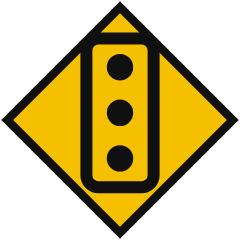
41. Why would this sign be installed on an approach?
Show answer
Answer B: Because the signal cannot be seen from far enough back for a driver to react in time
Advance notice of a signal is used where a crest, a curve, trees or a building keep the signal heads out of view until a driver is already too close to stop comfortably.
-
42. An emergency vehicle with flashing lights and a siren is approaching from behind on a two-way street. What should you do?
Show answer
Answer C: Pull over to the right edge of the road and stop until it passes
Clearing a path by pulling to the right and stopping gives the emergency vehicle a predictable route, while stopping in mid-lane or inside an intersection blocks that path.
-
43. What makes a left turn protected rather than permissive?
Show answer
Answer B: Oncoming traffic is held by a red signal while you have a green arrow
A protected turn is one where the conflicting movements are stopped by their own signal, which is what the green arrow indicates.
-
44. The engine begins to lose power, makes a loud noise and starts to seize. What should the rider do?
Show answer
Answer C: Pull in the clutch at once and coast off the road to a safe place
A seizing engine can lock the rear wheel, and pulling in the clutch separates it from the wheel so the motorcycle keeps rolling under control.
-
45. A pedestrian is crossing at a corner where no crosswalk is painted on the pavement. What is your duty?
Show answer
Answer A: Yield, because a legal crosswalk exists at the corner even without paint
Every intersection has a crosswalk whether or not it is marked, and drivers must yield to pedestrians crossing there.
-
46. After the leader of a staggered group completes a pass, what should the leader do?
Show answer
Answer A: Move to the left position and hold passing speed to open room for the next rider
Returning to the left position and keeping speed opens the gap the next rider needs to finish the pass and settle back into formation.
-
47. You are following a car at night with the high beam on. What should you do?
Show answer
Answer C: Switch to the low beam so the driver ahead is not blinded
A high beam fills the mirrors of the vehicle ahead and blinds its driver, which is dangerous for the very driver most able to affect the rider.
-
48. After a crash, what information should you exchange with the other driver?
Show answer
Answer B: Name, address, driver license, vehicle registration and insurance details
Identification, registration and insurance information are what the other party and the insurers need. Sensitive financial details are never required.
-
49. A face shield keeps fogging up in cool, damp weather. What helps?
Show answer
Answer A: Cracking the shield open slightly, or using an anti fog shield
Fog forms when warm breath meets a cold shield, so moving a little air behind the shield or using an anti fog design is the safe fix.
-
50. Is it acceptable to leave your vehicle across the entrance of an alley for a short time?
Show answer
Answer A: No, the entrance must stay clear at all times
Blocking an alley entrance traps the vehicles inside and can keep emergency services out, so it is prohibited however brief the stop.