
New Jersey MVC Motorcycle Practice Test 25
- Questions50
- Correct to pass40
- Passing score80%
- Minimum age17 years
-
1. A wide crosswalk you are turning across has a refuge island in the middle. What should you assume about people standing on it?
Show answer
Answer D: They may step off the island into your path at any moment
An island is a pause in a crossing, not the end of one, so treat anyone on it as a pedestrian who is still crossing.
-
2. After turning right you see a sign showing that your lane ends a short way ahead. What should you do?
Show answer
Answer B: Signal and merge into the next lane while there is still room
Merge early and smoothly while a gap is still available, rather than running out of pavement or forcing your way in at the last moment.
-
3. Two left-turn lanes are marked at the intersection and you are in the left one. What must you do?
Show answer
Answer A: Stay in your own lane all the way around the turn
With dual turn lanes each driver must hold a lane through the whole turn and come out in the matching lane of the new street.
-
4. To make a motorcycle lean into a turn at normal riding speed, the rider should:
Show answer
Answer C: Press forward on the handgrip on the side of the turn
This is countersteering: press left to lean left and go left, press right to lean right and go right.
-
5. A center lane is bordered by a solid yellow line on the outside and a broken yellow line on the inside, with turn arrows painted inside it. What is that lane for?
Show answer
Answer C: Left turns made by traffic traveling in either direction
That marking pattern identifies a two-way left-turn lane, which drivers approaching from both directions may use to prepare for a left turn.
-
6. You are the first driver on a road just after a storm. What should you plan for?
Show answer
Answer B: Branches, mud and other debris hidden around the next bend
Storm debris lands where nobody has cleared it yet, often just beyond a curve or a crest, so reduce speed and look much further ahead.
-
7. Federal law lets a state open its high-occupancy vehicle lanes to certain vehicles carrying only one person. Which of these is covered by that allowance?
Show answer
Answer B: Motorcycles
Federal law lets states allow motorcycles into high-occupancy vehicle lanes regardless of the number of occupants, because keeping riders in the flow is safer than the alternative.
-
8. What is sensible when you drive in an unfamiliar town for the first time?
Show answer
Answer C: Drive a little slower and give yourself more time to read the signs
In unfamiliar surroundings you need longer to take in signs, junctions and markings, and lower speed buys that time.
-
9. The lane control signal above your lane changes to a steady yellow X. What should you do?
Show answer
Answer A: Prepare to leave the lane, because it is about to be closed
A steady yellow X is the warning that the lane below it is about to close, giving drivers time to move over before the red X appears.
-
10. How much of a traffic lane is a motorcycle entitled to use?
Show answer
Answer D: The full width of the lane
A motorcycle is entitled to the full lane, and riders move within it to stay visible and to avoid surface hazards, so drivers should never try to share a lane with one.
-
11. The circular sign shape is reserved for which warning?
Show answer
Answer C: Advance warning of a highway-rail grade crossing
A round yellow sign with a black X and the letters RR is the grade crossing advance warning sign, and the circular outline is used for no other message.
-
12. Why do drivers so often misjudge how fast an approaching motorcycle is traveling?
Show answer
Answer C: A narrow vehicle seems to grow slowly, so it appears further away
A small frontal area changes size slowly as it approaches, so drivers read a motorcycle as further away and slower than it really is. Never assume a waiting driver has judged your speed correctly.
-
13. Which feature matters most in clothing meant to keep a rider warm?
Show answer
Answer C: A windproof outer layer, since moving air strips body heat fast
Wind blowing through clothing carries away heat faster than anything else, so a windproof outer shell over insulating layers is what keeps a rider warm.
-
14. What does this sign tell a driver about the road ahead?
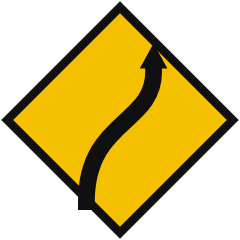
Show answer
Answer A: The roadway changes direction ahead, so speed should be reduced before reaching it
It gives advance notice of a change in alignment so the driver can slow down before entering, since braking inside a bend uses up grip that is needed for steering.
-
15. What happens if a passenger leans the opposite way to the rider in a curve?
Show answer
Answer B: The motorcycle becomes harder to steer and may run wide in the curve
A passenger leaning against the turn fights the lean angle the rider has set, forcing extra steering effort and pushing the machine toward the outside of the curve.
-
16. A driver who wants to reverse direction arrives at this sign. What is allowed?
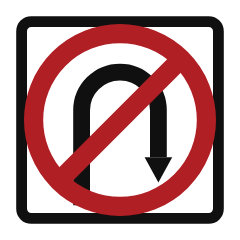
Show answer
Answer C: Going on and reversing direction only where the maneuver is permitted
The restriction removes that maneuver at that spot entirely, so the driver has to continue and turn the vehicle around at a place where it is not prohibited.
-
17. You spot a deep pothole that the riders behind you will not be able to see until it is too late. What is the usual way to warn them?
Show answer
Answer B: Point at it with a hand or a foot on the side it lies on
Pointing at the hazard on the correct side tells the riders behind both that something is there and where in the lane it is.
-
18. What should a rider check about the size of a motorcycle before riding it?
Show answer
Answer C: That both feet reach the ground and the controls are within reach
A motorcycle that fits lets the rider put both feet down at a stop and work every control without stretching, and a machine that is too tall or too heavy is hard to hold up in slow traffic.
-
19. You are on an entrance ramp merging onto a freeway. Who has to give way?
Show answer
Answer B: You must yield and fit into a gap in the traffic already on the freeway
Traffic entering a highway must yield to traffic already on it. Use the acceleration lane to match speed and merge into a gap.
-
20. You are stopped at a red light ready to turn right when a person pushing a stroller steps into the crosswalk. What should you do?
Show answer
Answer A: Stay stopped until they have crossed your path
A turn on red gives way to every pedestrian in the crosswalk, and someone pushing a stroller has even less room to react.
-
21. In heavy fog at night on a rural two-lane road, which marking best helps a driver hold position?
Show answer
Answer C: The solid white line along the right edge
Steering by the right edge line keeps a driver clear of oncoming traffic, while watching the center line tends to pull the vehicle toward it.
-
22. You are stopped at a stop sign where your road ends at a two-way through street and you plan to turn left. What must you yield to?
Show answer
Answer B: Traffic from both directions and any pedestrians crossing
A left turn from the stem of a T crosses the near lane and joins the far one, so you give way to traffic in both directions and to pedestrians.
-
23. Which of these is announced with the same family of signs as the facility shown here?
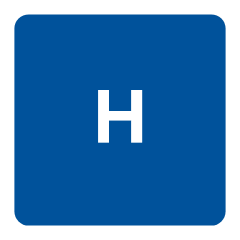
Show answer
Answer A: A rest area for travelers
A rest area belongs to the same motorist service series, which points travelers toward facilities such as fuel, food, lodging and medical care.
-
24. Why must a rider turn the head and look before changing lanes?
Show answer
Answer A: Mirrors leave blind spots that only a direct look can cover
Motorcycles have blind spots just as cars do, and a vehicle hidden in one will not appear in the mirrors at all.
-
25. A driver ahead brakes for no reason you can see, again and again. What should you do?
Show answer
Answer B: Increase your following distance and be ready for yet another stop
Unexplained braking tells you the driver is unsure or distracted, so the safe answer is more room, not less.
-
26. Where is a strong crosswind most likely to hit you suddenly?
Show answer
Answer D: Coming out of a tunnel or a cut onto an open bridge
Gusts arrive the moment you leave shelter, which is why bridge approaches and the ends of cuts and tunnels catch drivers out.
-
27. Why is hearing protection recommended even under a full face helmet?
Show answer
Answer D: Long term exposure to wind and road noise can cause permanent hearing damage
Airflow around a helmet produces high noise levels, and good hearing protection lowers that noise while still letting the rider hear horns and sirens.
-
28. You are traveling beside a solid white lane line. What does it tell you?
Show answer
Answer B: Crossing it is discouraged or prohibited, so stay in your lane
A solid white line separates lanes going the same direction where lane changing is discouraged or prohibited, such as where a through lane meets a mandatory turn lane.
-
29. A signal on an entrance ramp changes from red to green and lets one vehicle at a time onto the highway. What should you do?
Show answer
Answer A: Stop on the red and go on the green, one vehicle for each green
A ramp meter spaces vehicles out so they join the highway one at a time instead of arriving as a group, and it is a traffic signal like any other.
-
30. What is the recommended minimum following distance behind the vehicle ahead?
Show answer
Answer C: Two seconds
A two second gap is the minimum in good conditions and should be stretched to three seconds or more on slippery roads, in poor visibility or in heavy traffic.
-
31. How is the rear brake applied on a standard motorcycle?
Show answer
Answer D: By pressing down a pedal with the right foot
The rear brake pedal is in front of the right footrest and should be pressed down smoothly rather than stamped on.
-
32. Why is it useful to watch the vehicle two or three places ahead of you?
Show answer
Answer C: You get an earlier warning of slowing traffic than brake lights give
Trouble travels back through a line of traffic, so seeing it start several vehicles ahead gives you a head start on braking.
-
33. A traffic light ahead of the group turns yellow as the leader approaches it. What should the leader do?
Show answer
Answer C: Stop normally and let the group be split by the signal
Keeping the group together never outranks obeying the signal, and the riders left behind simply catch up at the next stop.
-
34. Where is reflective material most effective at attracting a driver's attention at night?
Show answer
Answer A: On the arms, legs and helmet, where the movement draws the eye
Reflective patches that move as the rider rides are noticed sooner than static ones, and a helmet sits high where drivers are already looking.
-
35. A large insect splatters on your face shield and blocks part of your view. What should you do?
Show answer
Answer D: Keep control, look through a clear part, and clean it at the next stop
Taking a hand off the bars or riding with your eyes closed is far more dangerous than a partly obscured view, so keep riding and clean the shield when you are stopped.
-
36. A traffic signal is displaying a flashing red light. How must you treat it?
Show answer
Answer D: Stop completely, then proceed when the way is clear
A flashing red carries the same meaning as a stop sign: come to a full stop, then go only when it is safe.
-
37. Which of the four blind spots around a tractor-trailer is the largest?
Show answer
Answer A: The one on the right side of the truck
A truck has no-zones on all four sides, and the right-side blind spot is the largest because it runs back along the trailer and reaches across more than one lane.
-
38. You enter a work zone where the top layer of pavement has been milled off, leaving a grooved surface. How should you ride?
Show answer
Answer B: Hold a relaxed grip and steady speed, and expect the tires to wander
Milled or grooved pavement makes the tires follow the ridges and the motorcycle feel unsettled, so relax on the bars, keep a constant speed and ride straight through.
-
39. You are in the right-hand lane of a multilane street and that lane becomes a right-turn-only lane ahead, but you want to go straight. What should you do?
Show answer
Answer B: Change into a through lane before you reach the markings for the turn lane
A lane-use arrow is a regulatory marking, so a driver who wants to continue straight has to leave that lane before it becomes a mandatory turn lane.
-
40. What is the main function of the guide sign series?
Show answer
Answer D: To identify routes and lead road users to their destinations
Guide signs identify routes, name destinations and give distances, so drivers can navigate without stopping to consult a map.
-
41. You are driving at night through heavy falling snow. Which headlight setting works better and why?
Show answer
Answer C: Low beams, because high beams bounce off the falling flakes back at you
Falling snow reflects light the way fog does, so high beams build a white wall of glare while low beams still give a usable view.
-
42. You have a green light at a school crossing, but the crossing guard steps out and holds up a stop sign toward you. What must you do?
Show answer
Answer A: Stop, because the crossing guard controls this crossing and outranks the signal
Directions from a crossing guard or a police officer take priority over signals and signs.
-
43. In a work zone, the flagger's instructions conflict with the pavement markings still visible on the road. Which do you follow?
Show answer
Answer B: The flagger, because a person directing traffic outranks the markings
An authorized flagger controlling a temporary traffic control zone overrides signs, signals and markings, and drivers must obey the flagger's signals.
-
44. At a stop sign with a painted stop line and a crosswalk, where must you stop?
Show answer
Answer D: At the stop line, before it and before the crosswalk
You stop at the stop line first, and only if there is no stop line do you stop before the crosswalk, and only if there is neither do you stop before entering the intersection.
-
45. How long should a head check before a lane change last?
Show answer
Answer D: A quick glance, so you do not lose track of what is happening ahead
Traffic ahead can change in a second, so the blind spot check is a fast glance and the rider returns attention to the road immediately.
-
46. What license does New Jersey require to operate an autocycle?
Show answer
Answer C: A valid basic driver license, with no motorcycle endorsement needed
An autocycle may be driven on a valid basic New Jersey license; no motorcycle license or endorsement is required, and autocycles may not be used for the road test.
-
47. What should you do with the key and your belongings when you leave the vehicle in a public lot?
Show answer
Answer D: Take the key with you, lock up and put valuables out of sight
Most vehicle thefts are opportunistic: a key left behind or a bag in plain view is the invitation.
-
48. Why must the handlebars be kept square during a hard straight line stop?
Show answer
Answer B: Because a front wheel turned under heavy braking can put the machine down
With the front tire loaded to its limit, any steering input asks it to do two jobs at once and the front end can wash out instantly.
-
49. Traffic in your lane is backed up and the paved shoulder looks clear. May you drive along it to get past?
Show answer
Answer C: No, the shoulder is not a travel lane
Passing must be done within the roadway; driving on the shoulder to get around traffic is prohibited and surprises anyone entering from the right.
-
50. In T-CLOCS, what does the letter O stand for?
Show answer
Answer B: Oil and other fluid levels
The O step covers engine oil, along with coolant, hydraulic brake fluid and any final drive fluid, plus a look underneath for leaks.