
New Jersey MVC Motorcycle Practice Test 26
- Questions50
- Correct to pass40
- Passing score80%
- Minimum age17 years
-
1. You must park on soft ground or on asphalt softened by heat. What should you do about the sidestand?
Show answer
Answer A: Put a flat, firm object under the stand to spread the load
A sidestand concentrates the weight of the machine onto a very small area, and on soft ground it sinks in until the motorcycle falls over.
-
2. You are turning right onto a one-way street. Which lane of that street should you enter?
Show answer
Answer C: The lane closest to the right curb
Even though every lane on a one-way street runs your way, a right turn must end in the lane nearest the right curb; you may change lanes afterwards when it is safe.
-
3. You want to turn left at an intersection with no signs or signals and a vehicle is coming straight toward you from the opposite direction. What must you do?
Show answer
Answer C: Yield and turn after the oncoming vehicle has passed
A driver turning left always gives way to oncoming traffic that is close enough to be a hazard, whether or not the intersection is controlled.
-
4. You reach a stretch of road covered by moving flood water of unknown depth. What is the correct decision?
Show answer
Answer D: Turn around and take another route
About a foot of moving water is enough to carry away most cars, and the roadbed under the water may already be washed out, so the only safe choice is to turn around.
-
5. An oncoming car is waiting to turn left across your path at an intersection. What is the safest response?
Show answer
Answer D: Slow, cover the brakes and pick a lane position that keeps an escape path
A car turning left in front of a rider is one of the most common motorcycle collisions, so the rider prepares to stop or swerve rather than trusting the driver to wait.
-
6. Why is reflective material more useful than bright color once it is dark?
Show answer
Answer C: It throws headlight light back toward the driver, while color goes unseen
Color needs daylight to be seen, while reflective material returns the beam of an approaching vehicle straight back to its driver.
-
7. Where is a U-turn most clearly unsafe and generally prohibited?
Show answer
Answer D: On a curve or near a hill crest, where other drivers cannot see you
U-turns are barred where approaching drivers cannot see you in time, such as on a curve or near the top of a hill.
-
8. You are traveling beside another vehicle on a multilane highway at nearly the same speed. Why is this a poor position?
Show answer
Answer B: You may be sitting in that driver's blind spot with nowhere to go if they move over
Driving alongside removes your side escape route and often puts you where the other driver cannot see you. Speed up or drop back to open space beside you.
-
9. A traffic signal is dark and you reach the intersection at the same moment as a vehicle on your right. Who goes first?
Show answer
Answer A: The vehicle on your right, as at any all-way stop
A dark signal is treated as an all-way stop, and the usual tie-breaker then applies: the vehicle on the right goes first.
-
10. You stop behind another vehicle at a traffic light. How much space should you leave?
Show answer
Answer D: Enough to see where its rear tires touch the pavement
Seeing the rear tires on the road leaves room to steer around the vehicle if it stalls, and gives a cushion if you are struck from behind.
-
11. What must a New Jersey applicant under 18 complete before receiving a motorcycle endorsement?
Show answer
Answer C: A Motorcycle Safety Education Program Basic Rider Course
New Jersey requires anyone under 18 to pass the state approved Basic Rider Course before the motorcycle endorsement is added.
-
12. An arrow panel at a work zone displays a flashing arrow pointing to the left. What does it require?
Show answer
Answer C: Move out of the closed lane into the lane on the left
A flashing or sequential arrow on an arrow panel directs traffic out of a closed lane and into the lane the arrow points to.
-
13. On a clear day with light traffic, a driver stays far below the maximum this sign sets. What can that cause?
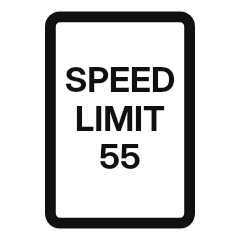
Show answer
Answer B: Obstruction of the normal flow of traffic, which is prohibited in itself
Driving so slowly that other traffic is impeded is an offense in its own right when nothing about safety, weather or the road calls for it.
-
14. Unless a sign says otherwise, what speed limit applies in a New Jersey suburban business or residential district?
Show answer
Answer C: 35 mph
Suburban business and residential districts default to 35 mph, ten above the limit set for ordinary business and residential districts.
-
15. Which warning sign keeps its yellow background even when it is used inside a work zone?
Show answer
Answer D: The grade crossing advance warning sign
The round grade crossing advance warning sign keeps its black legend on yellow inside temporary traffic control zones because the railroad hazard it describes is not temporary.
-
16. The signal ahead turns yellow while you are approaching it. What does the yellow light mean?
Show answer
Answer C: The red is coming; stop if you can do so safely
A steady yellow warns that the red is next. Stop if you can do so safely; enter the intersection only when stopping would be dangerous.
-
17. Beyond the point this sign refers to, which movement becomes unlawful?
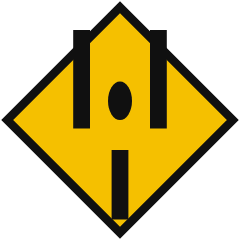
Show answer
Answer D: Driving on the far side of the separation, against the flow
Once the two directions are separated, each roadway carries one-way traffic, so crossing to the other side means driving into oncoming vehicles.
-
18. Is it acceptable to drive far below the flow of traffic on an open highway?
Show answer
Answer B: No, driving too slowly can obstruct traffic and create a hazard
Traffic that is much slower than the surrounding flow forces other drivers into sudden braking and unnecessary passing maneuvers, and impeding traffic is itself a violation.
-
19. The red lights on a stopped school bus go out and the bus begins to move away. What should you do?
Show answer
Answer B: Move off slowly and keep watching for children near the road
Children who have just left the bus may still be near the roadway or crossing behind it, so pull away gently and keep looking for them.
-
20. A driver is thinking about overtaking a slower vehicle and sees this sign a short distance ahead. What does it mean for that pass?
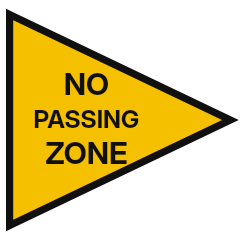
Show answer
Answer B: The pass must be finished before the restricted section begins
The sign marks the start of a section where passing is prohibited, so a driver may not be on the left side of the road beyond it; any pass has to be completed before that point or not started at all.
-
21. You are traveling in the same direction as a funeral procession and want to get ahead of it. What should you not do?
Show answer
Answer B: Driving in between the vehicles of the procession
Most states prohibit driving into or through a funeral procession, and cutting into the line leaves the drivers behind with no lead vehicle to follow, so go around only where passing is permitted.
-
22. You are riding a city street with embedded streetcar rails and it has just started to rain. What is the added risk?
Show answer
Answer D: Wet steel rails offer very little grip, and so does the pavement beside them
Steel rails give almost no traction when wet, so cross them upright at as close to a right angle as the lane allows, without braking or turning on the metal.
-
23. How should a rider dress for a long ride in very hot weather?
Show answer
Answer C: In ventilated riding gear that still covers the arms and legs
Mesh and vented riding gear flows air while keeping its abrasion protection and shading the skin, so heat is not a reason to ride uncovered.
-
24. The center line beside your lane is a broken yellow line. What does it allow?
Show answer
Answer D: You may cross into the opposing lane to pass when it is safe and clear
A broken yellow center line marks a passing zone where traffic in that direction may cross into the opposing lane to pass when the way ahead is clear.
-
25. You are about to pull out of a driveway when someone on the sidewalk is walking toward it. What should you do?
Show answer
Answer D: Wait, because traffic on the sidewalk has the right-of-way
A vehicle entering the roadway from a driveway yields to people on the sidewalk as well as to traffic on the street.
-
26. A yellow horizontal rectangular sign showing one large arrow pointing left or right, facing traffic on the far side of a sharp bend, tells the driver
Show answer
Answer C: which way the roadway turns at that point
The large arrow sign is mounted on the outside of a sharp change in alignment so that a driver approaching head on immediately sees which way the road goes.
-
27. Why do groups agree on a set of hand signals before setting off?
Show answer
Answer B: Because engine noise and helmets make speech useless between moving machines
Riders cannot talk to each other while moving, so agreed signals for hazards, stops, fuel and single file keep the whole group informed.
-
28. You have just ridden over a large object lying in the road. What should you do next?
Show answer
Answer A: Pull over when it is safe and check the tires and rims for damage
An impact can cut a tire, dent a rim or bend a fork without giving any immediate change in how the machine feels, so it deserves a look.
-
29. You reach a red light with a sign reading NO TURN ON RED. What may you do?
Show answer
Answer D: Wait for the green; no turn is allowed while the light is red
That sign removes the usual permission to turn on red at the intersection, so you must wait for a green indication.
-
30. The sun is low behind you and shining into the eyes of oncoming drivers. What should you do?
Show answer
Answer C: Turn on your headlights and expect oncoming drivers not to see you
Drivers facing the low sun may not see you at all, so make yourself as visible as possible and give way rather than insisting on your right of way.
-
31. A yellow sign shows a truck on a slope with the legend 7 PERCENT GRADE. What should a driver of a heavy vehicle do?
Show answer
Answer A: Select a lower gear before starting down
The percentage shows how steep the descent is, and choosing a low gear at the top lets the engine hold the vehicle back instead of the brakes overheating.
-
32. Where is passing prohibited even when no line is visible?
Show answer
Answer D: On a curve or near the crest of a hill, at intersections and at railroad crossings
Passing is prohibited wherever your view of oncoming traffic is blocked or where vehicles may cross your path, which includes hills, curves, intersections and rail crossings.
-
33. Yellow signs each showing one large black arrowhead, installed in a row along the outside of a curve, are
Show answer
Answer D: chevron alignment signs marking the change of direction of the curve
Chevron alignment signs are placed on the outside of a curve so that several are in view at once, letting the driver judge how sharply the road turns.
-
34. An officer directing traffic faces you and holds one hand up with the open palm toward your vehicle. What does the gesture mean?
Show answer
Answer D: Stop before reaching the officer
A raised open palm shown toward a driver is the standard signal to stop.
-
35. Why are pedestrians and cyclists a special risk on unlit streets at night?
Show answer
Answer A: Dark clothing can make them invisible until they are very close
A person in dark clothing reflects almost no light and may not appear until they are inside your stopping distance, so cut your speed where people may be about.
-
36. The vehicle ahead of you has pulled out to pass a truck. May you follow it out and pass as well?
Show answer
Answer B: No, wait until it is done and judge the road for yourself
You cannot see past the vehicle ahead of you, and if it has to abort the pass there is nowhere for either of you to go.
-
37. A rider uses only the rear brake for a quick stop. What is the result?
Show answer
Answer B: A much longer stop, and a rear wheel that locks easily
With weight thrown forward the rear tire has little grip left, so it gives up only a small share of the available braking and skids under heavy pressure.
-
38. If you must abandon a vehicle stuck on the tracks with a train coming, why do you move toward the train and away at an angle?
Show answer
Answer D: Because debris from the impact is thrown forward, away from the train
A train pushes wreckage down the track ahead of it, so walking toward the train and off to the side keeps you out of the debris path.
-
39. Four vehicles reach a four-way stop from all four directions at the same instant. How is the deadlock resolved?
Show answer
Answer C: Each driver yields to the vehicle on the right and they go one by one
Yielding to the right applies to every driver, so the group untangles itself as drivers take turns rather than moving together.
-
40. The rear tire loses air suddenly while you are riding. Which symptom should you expect and how should you respond?
Show answer
Answer D: The rear sways or feels heavy, so ease off and slow with the front brake
A rear flat makes the back of the motorcycle wallow or sway, so hold your line, close the throttle gently and slow mainly with the brake on the wheel that still has air.
-
41. A reduced speed limit posted with this sign and a plaque giving hours is in force
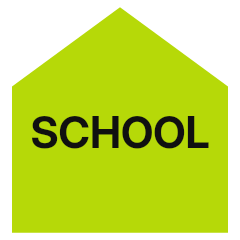
Show answer
Answer C: during the hours shown on the plaque, or while the beacon is flashing
A school speed limit applies during the periods stated on the plaque or while the attached beacon flashes, and the regular limit governs outside those periods.
-
42. You are approaching the entry of a modern roundabout. Who must you yield to?
Show answer
Answer C: Traffic already circulating in the roundabout, which approaches from your left
Traffic in a United States roundabout circulates counterclockwise, so drivers entering must look left and yield to vehicles already in the circulating roadway.
-
43. You are driving through patchy fog on a highway. What should you be ready for?
Show answer
Answer B: Sudden dense banks where visibility drops within a few car lengths
Patchy fog can go from clear to nearly blind in a moment, so keep your speed low enough that a sudden bank does not leave you without room.
-
44. You are riding directly into a low sun that is glaring off your face shield. What should you do?
Show answer
Answer A: Slow down and assume that drivers ahead of you cannot see you either
Glare cuts what everyone can see, so lower speed buys reaction time, and a driver blinded by the same sun is even less likely to notice a motorcycle.
-
45. How does higher speed affect the outcome of a crash?
Show answer
Answer A: It leaves less time to react and greatly increases the force of impact
Speed shortens the time available to avoid a hazard and raises the energy released in an impact, so both the likelihood and the severity of a crash increase.
-
46. You are the first to arrive at a crash on a rural road. What should you do first?
Show answer
Answer C: Park well clear of the scene, put on your hazard lights and call for help
Getting trained help on the way and keeping the scene visible does more good than anything an untrained bystander can do.
-
47. The leader gives a hand signal that you can see clearly from your place in the group. What should you do with it?
Show answer
Answer A: Repeat the signal so the riders behind you also receive it
Signals are passed down the line rider by rider, because riders further back cannot see the leader through the machines in between.
-
48. A NO LEFT TURN sign carries a plaque reading 7 AM TO 9 AM MON TO FRI. What does the assembly mean?
Show answer
Answer A: The turn is banned only during those hours on those days
A time plaque limits the restriction to the periods shown, so outside those hours and days the left turn may be made normally.
-
49. A single solid white line separates two lanes running in the same direction. What is it telling drivers?
Show answer
Answer A: Changing lanes there is discouraged
A solid white lane line discourages lane changing, typically where merging or weaving would create a hazard.
-
50. The handlebars begin to shake violently in a wobble at speed. What is the correct response?
Show answer
Answer C: Grip the bars firmly and close the throttle gradually, without braking
Braking or accelerating during a wobble usually makes it worse, so the rider holds on, rolls off gradually, and pulls off the road to find the cause.